
MTSEF Student Participation Guide
Your Guide to Registering for the MTSEF: Unlock Opportunities in Science, Technology, Engineering, and Mathematics!
MTSEF 2027 Important Registration Dates
August 15, 2026: Online student registration opens
December 4, 2026: Student registration closes
December 4, 2026: Scientific Review Pre-approval paperwork due
January 31, 2027: All paperwork and signed forms due (except abstract)
March 26, 2027: Digital poster and abstract due
New to the Fair?
Start your science fair journey by continuing below. You'll learn how to choose a project, determine which forms are required, register, and prepare for Fair Day.
Begin early! SOME research projects require Scientific Research Committee approval BEFORE experimentation begins.
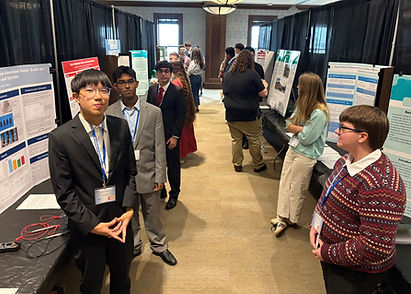
Follow The Steps Below to Participate
Follow the steps below to participate. They guide you through developing a project idea, completing forms, registering for the science fair, making a poster and competing at the MTSEF.
-
Develop a Project Idea
-
Develop your Research Plan and Review Required Forms for All Participants
-
Check if Additional Forms are Required
-
Register and Complete Forms in MySciFair
-
Begin Experimentation
-
Prepare for Fair Day
Project Ideas
1. Start With What You’re Curious About
-
Is there a subject I really enjoy?
-
Is there something I’ve always wondered about?
-
Is there a real-world problem I wish someone could solve?
-
Is there something I would like to design, build, or improve?
2. Turn Your Interest Into a Research Question
A good science fair project asks a clear and testable question. Your question should be:
-
Specific
-
Testable
-
Safe
-
Doable with the resources and time available
Example:
-
Too Broad: “Does music affect people?”
-
Better: “How does listening to classical music vs pop affect short-term memory in teenagers?”
If you are having trouble narrowing your research interest into a research question, prompt AI to ask you questions to help you come up with a testable and doable project.
3. Choose the Type of Project
Most science fair projects fall into one of these categories:
-
Experimental: Test how one variable affects another.
-
Engineering / Design: Design or improve a device or system.
-
Data Analysis: Answering questions using information from large databases
4. Plan Your Investigation
Once you have a question, plan how you will answer it.
-
Plan Your Method: How will you test your idea?
-
Collect Data: Perform experiments or gather observations.
-
Analyze Results: Look for patterns, differences, or trends.
-
Draw Conclusions: What does the data tell you?
-
Communicate Your Findings: Prepare report and display.
5. Using AI Tools Responsibly
AI tools can help brainstorm ideas or narrow a topic, but your project must still be your own work. For guidelines on using AI download the document below:
6. Safety and Ethical Guidelines
All projects must follow research rules established by the Society for Science, the organization that runs the Regeneron International Science and Engineering Fair. Starting early ensures there is enough time for proper review.
Important requirements:
-
Every student must have an Adult Sponsor (usually a teacher).
-
Some projects require approval before experimentation begins.
-
Projects involving human participants, animals, or hazardous materials have additional rules.
For more information on projects that require pre-approvals, see page 2 of ISEF Rules and Guidelines.
7. Helpful Resources
Middle school students exploring ideas and looking for inspiration?
-
Science Buddies – Project Idea Finder by grade and topic
-
NASA STEM Resources – Real-world science activities
High school students looking for inspiration?
Browse thousands of projects from past Regeneron International Science and Engineering finalists. Search by category, keyword, or year to explore previous research and read project abstracts.
Search the ISEF Project Database
Students interested in data analysis or computational projects may use publicly available datasets. Some examples of reputable sources include:
-
US Geological Survey: Earth science and environmental data
-
CDC Data: Public health and epidemiology data
-
National Oceanic and Atmospheric Administration: Weather and climate data
Students using datasets should:
-
Understand how the data was collected
-
Clearly explain their analysis methods
-
Draw conclusions supported by the data
Project Categories
Middle School Categories
Middle school projects are judged within grade-level categories:
• 6th Grade
• 7th Grade
• 8th Grade
High School Categories
High school projects at the Middle Tennessee Science & Engineering Fair (MTSEF) are grouped into scientific and engineering categories similar to those used at the Regeneron International Science and Engineering Fair (ISEF). Categories help ensure that projects are evaluated by judges with relevant expertise.
During registration, students will select the category that best matches their project. If a project could fit more than one category, choose the category that best reflects the primary focus of the research. The MTSEF Scientific Review Committee will review all entries and may adjust category placement if needed.
The categories listed below are based on the current ISEF categories. MTSEF categories will be similar, and in most years are identical, to those used by ISEF.
Not sure which category fits your project? Select the category that most closely matches your project's main research question or engineering goal. Final category placement will be determined by the MTSEF Scientific Review Committee.
-
Animal Sciences (ANIM)
-
Behavioral and Social Sciences (BEHA)
-
Biochemistry (BCHM)
-
Biomedical and Health Sciences (BMED)
-
Biomedical Engineering (ENBM)
-
Cellular and Molecular Biology (CELL)
-
Chemistry (CHEM)
-
Computational Biology and Bioinformatics (CBIO)
-
Earth and Environmental Sciences (EAEV)
-
Embedded Systems (EBED)
-
Energy: Sustainable Materials and Design (EGSD)
-
Engineering Technology: Statics and Dynamics (ETSD)
-
Environmental Engineering (ENEV)
-
Materials Science (MATS)
-
Mathematics (MATH)
-
Microbiology (MCRO)
-
Physics and Astronomy (PHYS)
-
Plant Sciences (PLNT)
-
Robotics and Intelligent Machines (ROBO)
-
Software Design (SFTD)
-
Technology Enhances the Arts (TECA)
-
Translational Medical Science (TMED)
Forms and Approvals
-
Before beginning your project, review the information below to determine which forms and approvals are required.
-
The ISEF Forms Packet provided in the link below is for reference and planning purposes ONLY. Official registration forms are completed through the MySciFair link in the registration section.
The Following Are Required for All Projects
Before Experimentation Begins
1. Research Plan (see page 3 in the Sample Forms Download above)
Your Research Plan must:
-
Describe the purpose and rationale of your project
-
Describe the procedures you plan to use
-
Explain how results will be analyzed
-
Address potential safety concerns and precautions
-
Be written in future tense
-
Include a literature review with references (APA format preferred, 6 references for high school)
For additional information on creating a research plan, consult page 10 of the ISEF
Rules Companion Guide in the link below.
Use the template below to assist in writing your research plan, deleting any highlighted sections that do not apply to your project.
2. Form 1 – Adult Sponsor Checklist
Must be completed BEFORE experimentation begins
-
Your teacher serves as your Adult Sponsor
-
Your Adult Sponsor reviews your Research Plan
-
Signature date must be prior to start date on #8 of Form 1A
3. Form 1A – Student Checklist
-
Includes project title
-
Includes experimentation start and end dates
-
Experimentation may not begin until all required approvals are completed
-
Start date listed in #8 must be after signature dates on Forms 1 and 1B
4. Form 1B – Approval Form
-
Signed by student and parent/guardian
-
Must be completed before experimentation begins
-
Signature date must be prior to start date listed on #8 of Form 1A
5. Photo Consent Form
-
Required for participation in MTSEF
Before or After Experimentation
1. Form 2A – Student Support Disclosure Form
-
Required for all projects
-
Documents the assistance received during the research process
-
May be completed before or after experimentation
After Experimentation
1. Write a summary of any significant changes to your research plan, if applicable.
2. Abstract
All projects must submit an abstract after experimentation is complete. The abstract:
-
Is limited to 250 words
-
States the research question
-
Briefly describes the methods
-
Summarizes key results
-
Provides a defensible conclusion
-
Is written in past tense
3. Prepare a digital copy of your poster in pdf format for submission in MySciFair. For posters that are not digital, simply take a photograph of you board and format it as a pdf.
4. Finalists selected to represent our fair at the International Science and Engineering Fair will be required to submit a 2 minute video about their project and a Quad Chart, a single page visual summary.
Determine if Additional Forms and Approvals are Required
If yes, additional forms and approvals are required BEFORE EXPERIMENTATION BEGINS.
Human Participants (e.g. surveys, interviews, behavioral observations)
Projects involving human participants require review before experimentation begins.
Additional Forms May Include:
-
Form 4 – Human Participants
-
Form 2B – Qualified Scientist: an individual with advanced expertise in a research area. See Guide on ISEF Rules under Rules and Guidelines
-
Form 3 – Risk Assessment • Informed Consent Forms Important:
-
Form 4 is required for all human participant projects
-
School-level IRB review is typically required
-
MTSEF SRC review is required
-
Additional forms depend on project risk level
For questions or details on Human Participants, see page 16 of the Companion Guide to the ISEF Rules in the link below.
Vertebrate Animals (e.g. fish, birds, and mammals)
All vertebrate animal projects require SRC approval before experimentation begins.
Non-Regulated Research Site (home, farm, etc.) Required Form:
-
Form 5A – Vertebrate Animal Form
Regulated Research Institution Required Forms:
-
Form 5B – Vertebrate Animal Form
-
Form 2B – Qualified Scientist: an individual with advanced expertise in a research area. See Guide on ISEF Rules under Rules and Guidelines.
Institution IACUC Approval
For questions or details on Vertebrate Animals, see page 22 of the Companion Guide to the ISEF Rules in the link below.
Potentially Hazardous Biological Agents (PHBA) (e.g. pond water, compost, bodily fluids, parasites, rDNA) and Environmental Risks
All PHBA projects require SRC approval before experimentation begins. Forms May Include:
Form 6A – PHBA Risk Assessment
Form 6B – Human & Vertebrate Animal Tissue Form
Form 3 – Risk Assessment
*NOT Considered PHBA: Baker's yeast, plant tissue, properly sterilized materials
If you are unsure, contact your teacher or src@mtsef.org before beginning experimentation.
For questions or details on PHBAs, see page 25 of the ISEF Rules and Guidelines in the link below.
For questions or details on Environmental Risks, see page 29 of the Companion Guide to the ISEF
Rules in the link below.
Hazardous Chemicals, Activities, or Devices (e.g. chemicals, explosives, controlled substances)
Projects involving significant safety risks may require additional review. Forms May Include:
-
Form 2B – Qualified Scientist: an individual with advanced expertise in a research area. See Guide on ISEF Rules under Rules and Guidelines
-
Form 3 – Risk Assessment
-
*Additional SRC review may be required before experimentation begins.
For questions or details on Hazardous Chemicals see page 25 of the Companion Guide ISEF Rules in the link below.
Research Conducted at a Regulated Research Institution (e.g. Universities, Hospitals, and Industrial Facilities)
Form 1C – Regulated Research Institution Form
*Important: Completed by the designated supervisor
Signed after experimentation is complete
Must be placed in front of your poster during MTSEF
Continuation & Longitudinal Projects
Form 7 – Continuation/Research Progression Projects
*Important: Significant expansion beyond previous work is required
Prior SRC approval may be required
Need Help?
If you are unsure which forms apply to your project, consult your teacher before beginning experimentation or contact MTSEF for guidance at src@mtsef.org.
MTSEF Rules And Guidelines
The documents below provide guidance on the International Science and Engineering Fair (ISEF) rules used by MTSEF. They explain the responsibilities of students, Adult Sponsors, and Qualified Scientists, and include detailed requirements for projects involving human participants, vertebrate animals, potentially hazardous biological agents (PHBA), and hazardous chemicals, activities, or devices.
If you have questions about the rules or are unsure which requirements apply to your project, consult your teacher or contact MTSEF before beginning experimentation.
For guidance on the ethical use of generative AI in scientific research projects, download and consult the document below.
Student Registration
STOP BEFORE REGISTERING make sure you have reviewed all forms and read the information above.

Fair Day
Fair Day is your opportunity to present your research and discuss your work with judges. Review the guidelines below to ensure your project meets all display and participation requirements. For details, consult the Display and Safety Rules link button below.
1. Project Display Requirements
Size Restrictions
All project displays must follow these maximum dimensions:
-
Depth (front to back): 30 inches (76 cm)
-
Width (side to side): 48 inches (122 cm)
-
Height (floor to top): 108 inches (274 cm) including display table
Important:
-
Fair-provided tables generally do not exceed 36 inches in height.
-
Table height is included in the total 108-inch height limit.
2. Required Abstract
An abstract is required for all projects.
-
The abstract is not attached to the display board.
-
It is placed on the table in front of the display board.
-
The abstract must follow the 250-word limit and be written in past tense.
3. Items NOT Allowed on Displays
To ensure fair judging, the following may NOT appear on your display:
-
School names
-
School logos
-
School photographs
-
Mentor names or photographs
-
Research institution names, logos, or photographs
-
Links to outside websites or QR codes
4. What to Include on Your Display
A typical project display includes:
-
Project title
-
Research question or problem statement
-
Background information
-
Hypothesis (if applicable)
-
Materials and procedure
-
Data (tables, graphs, images)*
-
Analysis
-
Conclusion
-
Bibliography (optional)
Your logbook or notebook should be available for judges if requested.
Form 1C MUST be displayed in front of your poster if applicable.
*All images and student generated graphs must be properly cited following the Display and Safety Rules.
See the link below for details:
Verify all references. Inaccurate references will result in disqualification.
*Citation generators often result in inaccurate references. Accurate references are critical for scientific integrity.
5. Prohibited Items at the Display
The following items are not permitted unless specifically approved:
-
Hazardous chemicals
-
Open flames
-
Live animals
-
Human or animal tissue
-
Microorganisms
-
Bodily fluids
-
Sharp objects
-
Dry ice
-
Pressurized containers
If your project involved hazardous materials or biological agents, photographs or simulations should be used instead of physical samples. For details see the link to Display and Safety Rules at the top of the page.
6. Dress Guidelines
-
Dress neatly and professionally.
-
Choose attire that is comfortable.
-
Students often stand for extended periods of time.
-
Business or business-casual attire is recommended.
7. Preparing for Judging
-
Practice explaining your project clearly and confidently within 7 minutes.
-
Be prepared to discuss your research question, procedures, and results.
-
Use your display board to guide your explanation.
-
Be honest about limitations and future improvements.
-
Show enthusiasm for your work.
Awards
Students at the Middle Tennessee Science & Engineering Fair are recognized for excellence in scientific research, engineering design, and innovation.
Top projects at MTSEF advance to national and international competitions:
-
High School Finalists represent MTSEF at the Regeneron International Science and Engineering Fair, the world’s largest international STEM research competition for high school students.
-
Middle School Finalists are eligible to compete in the Thermo Fisher Junior Innovators Challenge, a national virtual competition recognizing top middle school researchers.
Finalists receive support to attend these competitions, along with additional recognition for their achievement.
Students selected as High School Finalists must submit a two minute video summary and a Quad Chart shortly after MTSEF in order to compete at ISEF.
Category Awards
High School projects are judged within scientific and engineering categories.
-
First, Second, and Third Place awards are presented in each category.
-
Awards include monetary prizes and/or other forms of recognition: 1st place awards - $100, 2nd place awards - $75, 3rd place awards - $50
Middle School projects are judged within individual grade categories and also include monetary prizes and/or other forms of recognition.
Special Awards
High school and middle school students are eligible for a wide range of Special Awards made possible through the support of our sponsors and partners.
These awards recognize specific areas such as:
-
Innovation and creativity
-
Engineering and technology
-
Environmental research
-
Biomedical and health sciences
Special awards may include:
-
Monetary prizes
-
Certificates
-
Other forms of recognition